CMA Certification for Medical Assistants: What It Is and Why It Matters in Tulsa
A lot of people finishing medical assistant training are surprised by how much weight employers put on certification. Not just any training program completion — actual, nationally recognized credentials that prove your clinical knowledge meets a defined standard.
The most commonly required credential is the CCMA — Certified Clinical Medical Assistant — issued by the National Healthcareer Association (NHA). Here’s what it covers, why it matters, how the exam works, and how earning it affects your career from day one in Tulsa and beyond.
What CMA certification actually is
“CMA” stands for Certified Medical Assistant. There are several certifying bodies, but the CCMA through the NHA is among the most widely accepted by employers across the country. It’s a national credential earned by passing a standardized exam — not a school certificate of completion, but an independently verified test of clinical and administrative competency.
The exam tests knowledge across the full scope of medical assisting:
- Medical law, ethics, and HIPAA compliance
- Medical terminology and anatomy
- Infection control and OSHA compliance
- Phlebotomy and specimen collection
- Vital signs and patient assessment
- EKG/ECG fundamentals
- Medication administration and pharmacology basics
- Administrative procedures and EHR documentation
Passing this exam tells employers you’ve met a national benchmark — regardless of where you trained or how long your program was.
Why employers treat the CCMA as a baseline requirement
It’s a reliable signal of competency
Employers can’t watch every applicant perform a blood draw in an interview. The CCMA gives them an objective reference point. A certified candidate has demonstrated passing knowledge across the full scope of the role. An uncertified candidate requires the employer to take that on faith.
In high-volume hiring settings — group practices, specialty clinics, urgent care chains — the CCMA is often the first filter in the applicant review process. Applications without it may not advance regardless of other qualifications.
It directly affects your starting salary
According to Indeed and Glassdoor (2026), the salary difference between certified and non-certified medical assistants at entry level is approximately:
- Non-certified MA starting range: $32,000–$36,000/year
- CCMA-certified MA starting range: $36,000–$42,000/year
That gap of $2,000–$6,000/year compounds over time. Over a five-year career, certification at the start adds up to $10,000–$30,000 in additional earnings — on top of a faster, smoother job search.
It expands which positions you can apply for
Some specialties — oncology, cardiology, dermatology — prefer or require CCMA certification for clinical roles from day one. Without it, your options are limited to practices willing to hire and train uncertified staff. With it, the full range of practice types and specialties is open from the start.
It’s nationally portable
The CCMA follows you across employers, cities, and states. If you move, change practices, or transition between specialties, the credential remains valid. It doesn’t reset or lapse when you change jobs. Renewal is every two years through continuing education — which most working MAs accumulate naturally through employment.
How the CCMA exam works
The exam is administered by the NHA at approved testing centers or via remote proctoring online.
Exam format:
- 150 multiple-choice questions
- 3-hour time limit
- Scaled scoring system (not percentage-based)
Domains covered:
- Medical terminology and anatomy — body systems, anatomical terminology, clinical abbreviations used in charting and verbal communication
- Medical law, ethics, and HIPAA — patient rights, informed consent, scope of practice, privacy rules, mandatory reporting
- Patient intake and documentation — vital signs procedures, chief complaint documentation, medical history review, EHR entry standards
- Clinical procedures — phlebotomy, intramuscular and subcutaneous injections, EKG electrode placement, specimen collection, wound care assistance
- Infection control — OSHA bloodborne pathogens standard, sterilization methods, PPE protocols, biohazard disposal
- Pharmacology — drug categories, routes of administration, dosage documentation, common side effects and contraindications
- Administrative functions — scheduling, insurance verification, prior authorizations, referral coordination, patient communication
Passing: The NHA uses a scaled score. Students who complete programs with integrated CCMA preparation — where exam content is woven throughout the curriculum, not reviewed in a final week — consistently pass at higher rates.
Preparing for the exam: what actually works
Integrated curriculum preparation
The most effective preparation for the CCMA isn’t cramming. It’s a training program that maps every module to CCMA exam domains — so by the time you’re in week 12 or 16, you’ve been reviewing exam content the entire time, not encountering it for the first time.
Hands-on clinical practice
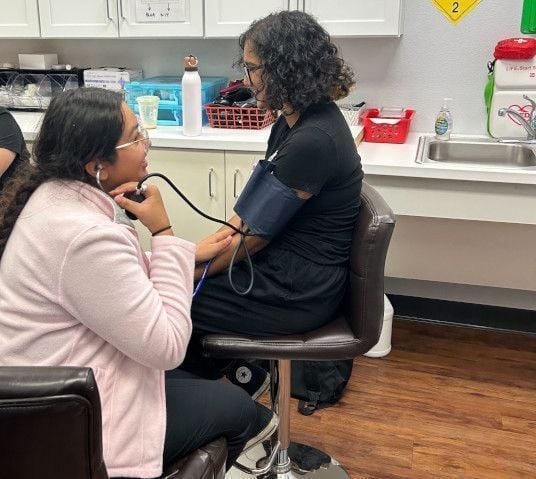
The CCMA assesses clinical competency. Hands-on practice in real clinical environments — performing phlebotomy, running EKGs, administering injections — builds the physical skill and procedural memory that written exam questions test from the knowledge side. Students who train in real medical offices are measurably better prepared for the clinical portions of the exam.
Consistent assessment throughout
Practice questions and module assessments throughout the program identify knowledge gaps early — when there’s still time to address them — rather than revealing them the night before the exam.
What happens after you pass
Certified graduates in Tulsa typically find employment within 2–4 weeks of passing the CCMA. The job search is faster, initial offers are higher, and the interview process moves more quickly because the credential answers the employer’s primary question before it’s asked.
Common first positions for CCMA holders:
- Primary care / family medicine MA — broad clinical skills, consistent patient volume, good starting salary
- Urgent care MA — fast-paced, varied presentations, often flexible scheduling with competitive pay
- Specialty clinic MA — higher average salary, more procedure-specific skills, typically accessible after 1–2 years in general practice
- Hospital outpatient department MA — stable employment, structured advancement paths, full benefits
Frequently asked questions about CMA certification
Do I need prior healthcare experience to sit for the CCMA exam? Most pathways require completion of an accredited medical assistant training program. Prior clinical work experience is not required as a prerequisite — training programs are designed to build that foundation from scratch.
How often do people pass on the first attempt? Candidates who complete comprehensive, clinically-integrated programs with built-in exam prep consistently pass at higher rates than those who self-study or completed shorter, less structured programs. First-attempt pass rates vary by program quality.
Can I retake the exam if I don’t pass? Yes. The NHA allows retakes after a waiting period. Most training programs provide support for students preparing to retake.
Is the exam fee included in program tuition? This varies by program. Always confirm the all-in cost — including exam fees — before enrolling. Some programs include it; others charge it separately after graduation.
What the CCMA changes about your first job search
Certified graduates approach the job search from a fundamentally different position than non-certified ones. Here’s what that difference looks like in practice:
Application screening: Many practices filter applications by certification status before reviewing anything else. A CCMA credential ensures your application reaches the hiring stage rather than being screened out before a human reads it.
Interview conversations: Non-certified candidates spend part of the interview establishing basic competency. Certified candidates spend that same time discussing the role, the practice culture, and salary expectations. The CCMA answers the competency question before the interview begins.
Initial offers: Managers who’ve hired both certified and non-certified MAs consistently report offering higher starting rates to certified candidates — because they’re less likely to need remedial onboarding and more likely to be productive immediately.
Negotiating position: The CCMA gives you documented leverage. When a practice offers you $36,000 and the market median for certified MAs in Tulsa is $40,000, you have something concrete to point to. That negotiating position is genuinely different from asking an employer to trust your word about your clinical skills.
How this program prepares you for the CCMA
Our medical assistant training program integrates CCMA exam preparation throughout the entire curriculum — not as a final-week review session. Every clinical module maps to an exam domain. Hands-on training in real medical offices builds the procedural skills the exam assesses. By graduation, you’ve been preparing for the credential the entire time.
You're only a few months from the medical assistant career you deserve.